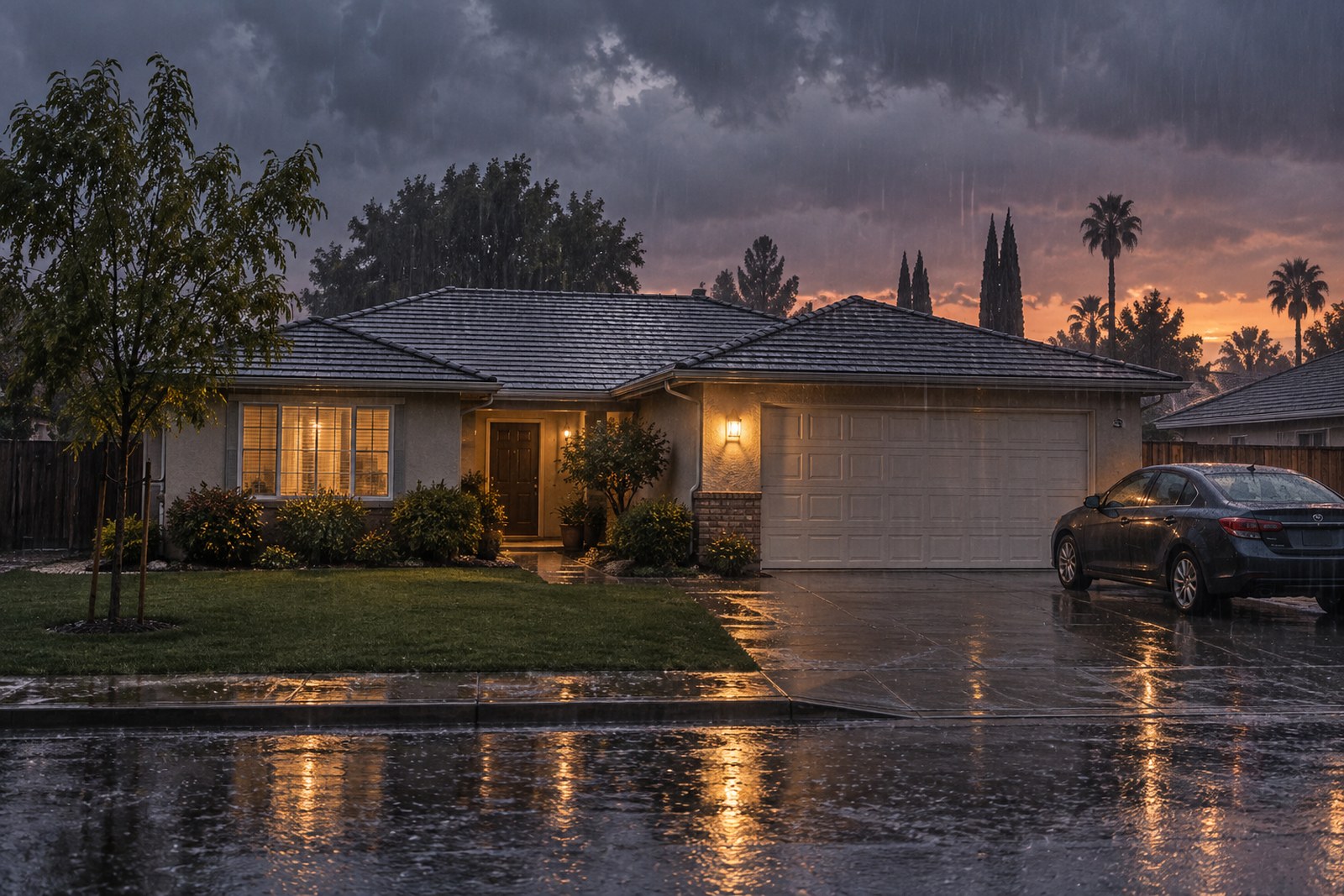
A property manager calls because a tenant has a bucket in a stockroom. The first quote they get is for a full tear-off, six figures, three weeks of noise and a capital request nobody budgeted. Sometimes that is genuinely the answer. Far more often, the roof is fine and one detail on it is not.
Here is how commercial roof leak repair actually gets diagnosed on a low-slope roof, what the honest options cost in effort and disruption, and how to tell when a coating is a real repair versus a paint job over a problem.
Why Do Commercial Flat Roofs Leak?
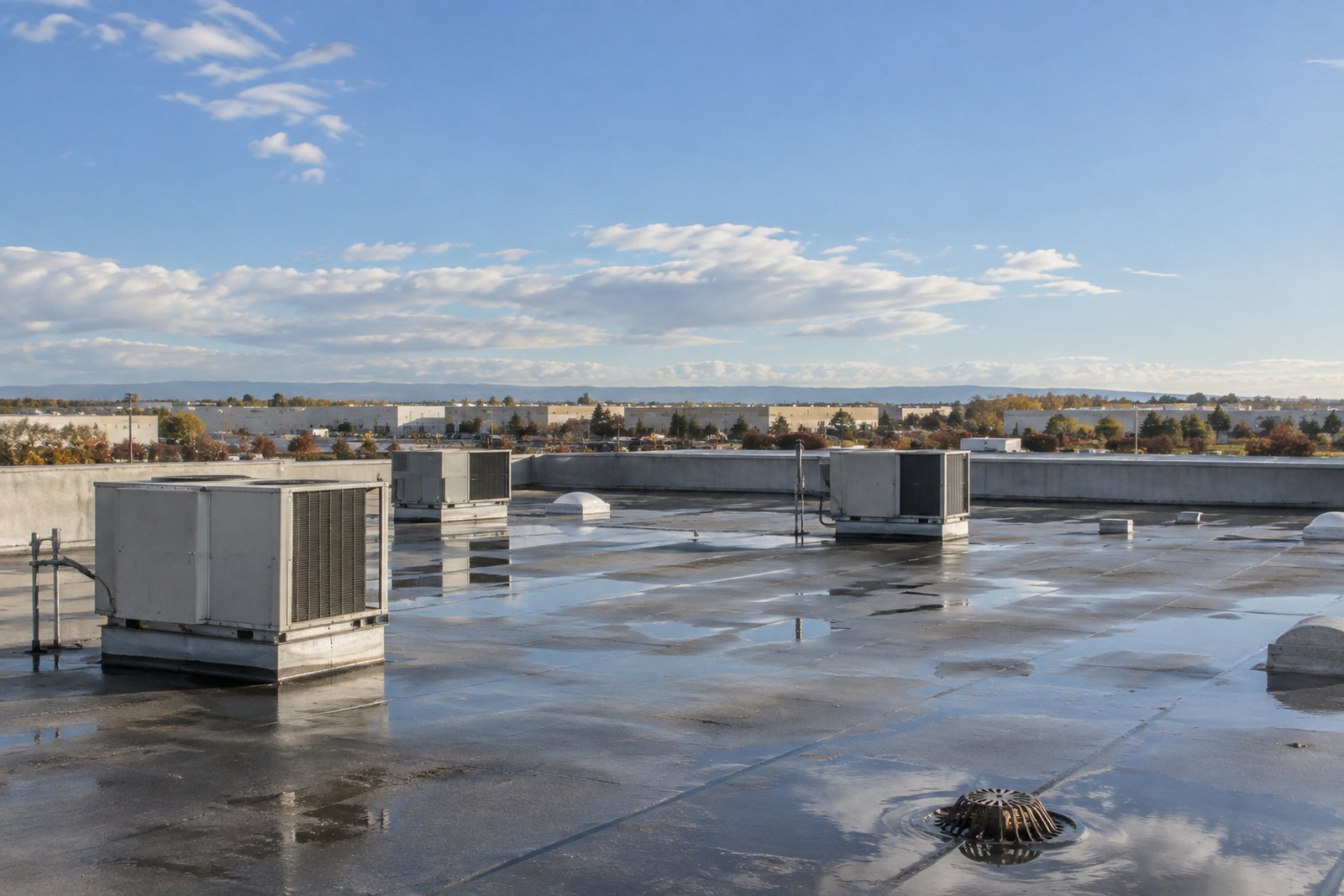
Flat roofs do not shed water, they hold and route it. So they fail at the places where the waterproofing is interrupted, not in the open field:
Seams. Every roll of TPO, EPDM or modified bitumen meets another one. Heat-welded TPO seams open up as the membrane ages and shrinks; older adhered seams simply let go. Seams are the number one source we find.
Penetrations. HVAC curbs, pipe supports, conduit, gas lines, vents, sleeper blocks for a new rooftop unit. Every one is a hole that someone hand-flashed, and every trade that has been on that roof since drilled next to it.
Drains, scuppers and crickets. A clogged drain turns a low spot into a pond, and a pond finds the nearest weakness. On a roof designed for a quarter-inch per foot of slope, a crushed insulation area or a settled deck creates ponding that never dries.
UV and thermal cycling. Valley summers are brutal on a black or gravel roof. Surface temperatures well above ambient drive expansion and contraction daily; that movement is what tears seams and cracks flashings over ten to twenty years.
Foot traffic and prior work. Kitchen grease, a cell carrier's install, a solar array, a satellite dish. A surprising share of leaks we trace are punctures dated to whoever was up there most recently.
None of those five is a reason to replace a roof. All five are reasons to repair a specific detail.
How Do You Find a Leak on a Flat Roof?
By elimination, in a fixed order — never by guessing and caulking.
- Interior mapping. Note where the water shows and which direction it runs on the deck above. On a steel deck, water travels down flutes and can surface many feet from the entry point.
- Drain and scupper check. Clear them first. A shocking number of "leaks" are simply drainage, and they cost nothing to rule out.
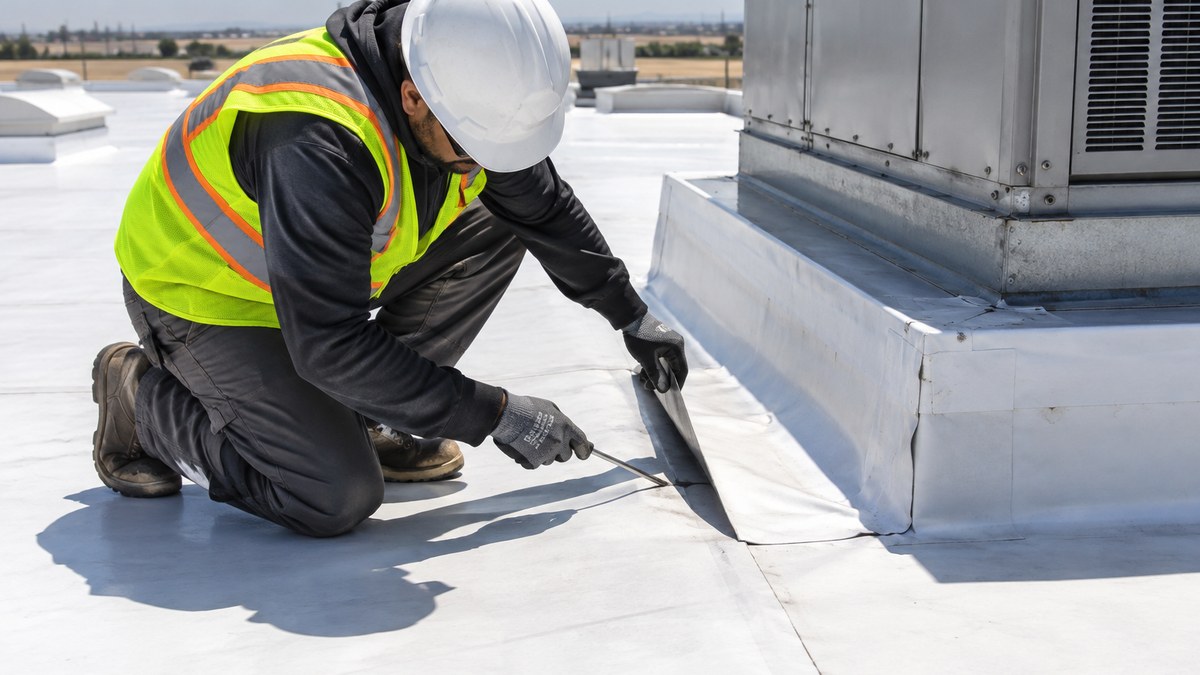
- Penetration walk. Photograph and probe every curb, pipe, support and termination bar. Pull-tested sealant beats visual inspection.
- Seam probe. A blunt seam probe along welds finds voids the eye misses.
- Water testing. Flood a suspect area section by section, uphill of the interior stain, with someone watching inside.
- Moisture survey. Infrared or capacitance scanning tells you how much of the insulation is wet — the single number that decides repair versus replacement.
That last step is the one skipped most often, and it is the one that protects you. Wet insulation does not dry out under a new coating; it rots the deck and destroys your R-value while the roof still looks new. Any contractor recommending a coating without telling you how much saturated insulation is up there is guessing with your building.
Can a Coating Really Fix a Leaking Roof?
Yes — inside clear limits, and no outside them.
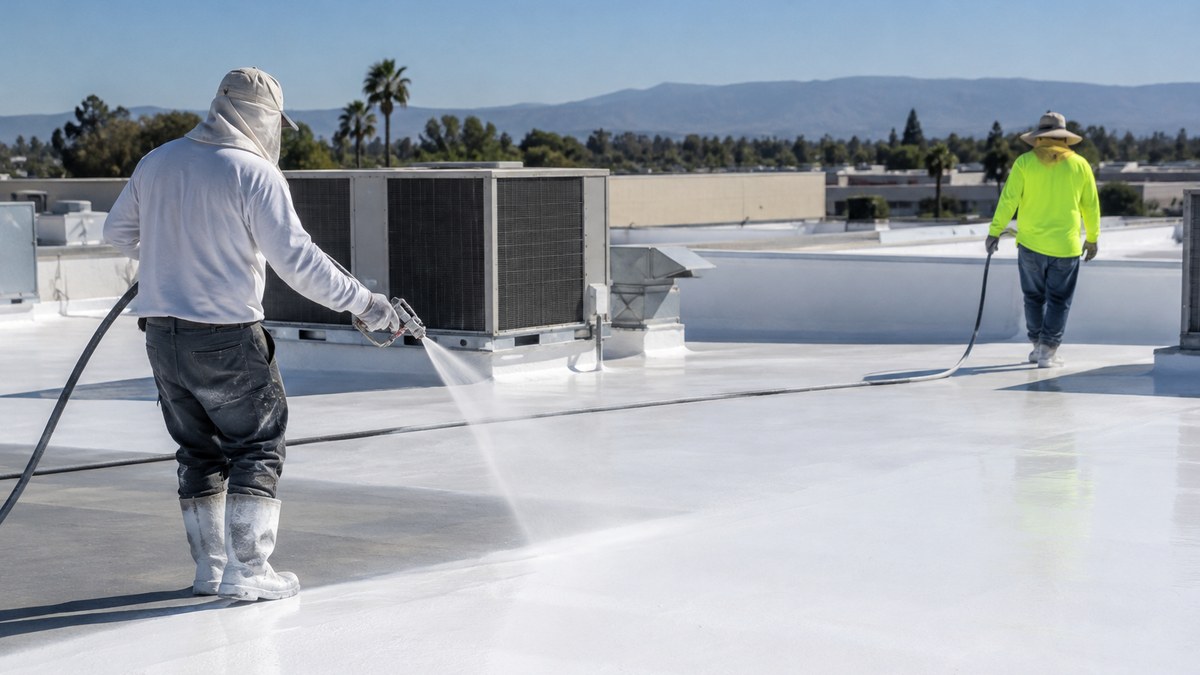
A fluid-applied silicone restoration is a monolithic membrane sprayed or rolled over the existing roof. It handles ponding water without breaking down, stands up to UV better than almost anything else on a low-slope roof, and reflects heat, which is a real operating-cost item in Fresno. It is done with the building occupied, over a weekend, with no tear-off and no dumpsters — usually the deciding factor for a tenant-occupied property.
The conditions it needs:
- The insulation is dry (or the wet areas are cut out and replaced first).
- The deck and structure are sound. Coating does not add strength.
- Details are repaired first. Seams, curbs, drains and terminations get reinforced with fabric before any field coat.
- The membrane is compatible and properly cleaned and primed. Silicone over contaminated or greasy surfaces fails at the bond, not in the film.
- It goes on at the required thickness. Warranty length is a function of dry-mil thickness and gallons per square — not of the brand on the bucket. Ask for the spec sheet and the coverage rate in writing, and ask whether the warranty is material only or a system warranty that includes labor.
Done that way, a restoration carries a manufacturer warranty and resets the clock on a roof for a fraction of a tear-off, and it can often be repeated later. Done wrong — thin, over wet insulation, without detail work — it buys about two years and complicates the eventual replacement. We do this work as fluid-applied roofing and we will tell you when a building does not qualify.
When Is Replacement Actually the Right Call?
Four situations where restoration is the wrong answer and we say so:
Widespread wet insulation. As a working rule, once roughly a quarter or more of the insulation is saturated, you are coating over a wet sponge. Tear off the wet, or tear off the roof.
Structural or deck damage. Rusted steel deck, rotted wood, deflection that creates new ponding. Fix the structure, then talk about the roof.
Too many layers. Code limits how many roofs can stack, and if the existing assembly is already at the limit, the next move is removal.
End of service life with a long hold period. If the membrane is shot, seams are failing everywhere, and the owner intends to hold the asset for another twenty years, a new flat roof replacement is the cheaper decision over that horizon even though it costs more today.
Honest math beats a cheap quote. Ask any bidder for the cost per square foot, the expected remaining service life of each option, and the warranty in years and type. Two of those three numbers usually make the decision obvious.
What Should Building Owners Do Between Storms?
Flat roofs reward maintenance more than any other roof type, because nearly every failure starts small and visible.
Twice a year, plus after any major storm: clear all drains, scuppers and gutters; walk the roof for punctures and opened seams; check every curb and pipe boot; look for ponding that persists more than 48 hours after rain; confirm nobody has left tools, screws or debris behind.
Keep a roof file. Date, photos, what was done, by whom. It is the difference between a warranty claim that pays and one that gets denied for lack of maintenance records — and it makes the next owner's due diligence painless.
Control roof access. One line in your HVAC, solar and telecom contracts requiring the vendor to notify you before roof work, and to have any penetration flashed by a roofer, eliminates a whole category of leaks.
A documented inspection report also gives you something to hand a lender, an insurer or a board. Our team does this across Fresno, Clovis, Madera, Visalia and the Bay Area — see commercial roofing for what an inspection includes.
Free commercial roof inspection and moisture check
We document seams, penetrations, drains and wet insulation, then quote repair, restoration and replacement side by side so you can compare cost per square foot.
Book a commercial inspectionor call (559) 550-6398
Frequently asked questions
How much does commercial flat roof repair cost?
Single-detail repairs — a seam section, a pipe boot, a curb re-flash, a drain — typically run a few hundred to a couple thousand dollars depending on access and how much wet insulation must come out. A silicone restoration is priced per square foot and lands well below replacement for the same area, with warranty length driven by coating thickness. Replacement is the highest number and the longest disruption. Get all three quoted as cost per square foot so they are comparable.
How long does a silicone roof coating last?
Warranties are commonly offered in the ten-, fifteen- and twenty-year range, and the term is tied directly to the dry-mil thickness applied, not to the brand. That means gallons per square is the number to verify in the proposal. Silicone holds up to ponding water and UV better than most alternatives, and a coated roof can usually be recoated at the end of the term rather than torn off.
Is a roof coating the same as a roof repair?
No. A coating is a field-wide protective membrane; it is not a substitute for fixing a failed detail. Seams, curbs, drains and terminations must be repaired and reinforced with fabric before the field coat goes on. A coating sprayed over an unrepaired penetration hides the problem for a season and then leaks in the same place.
Can you coat a roof with wet insulation underneath?
Not without removing the wet areas first. A coating is vapor-retardant, so trapped moisture stays trapped, ruins insulation value and can rot a steel or wood deck. That is why an infrared or capacitance moisture survey comes before the proposal — you need to know what percentage of the assembly is saturated before anyone quotes a restoration.
Will repairs disrupt my tenants?
Far less than a tear-off. Detail repairs are typically a day with no interior access needed, and a restoration is usually done in a weekend or off-hours with no demolition, no dumpsters and no debris in the parking lot. Tear-off is the disruptive option: open deck, noise, odor and staged material for days or weeks, which is one more reason to confirm whether you really need one.
Infinite Roofing Solutions is a licensed California roofing contractor (CSLB #1126804, B / C-39) serving commercial and industrial property owners in Fresno, Clovis, Madera, Visalia, the Central Valley and the Bay Area. Costs and warranty terms above are general ranges, not a quote — every roof gets measured. Call (559) 550-6398 for an inspection.